Thursday, January 8, 2009

Palazzo Vecchio

The Palazzo Vecchio was intended to be the seat of government for the city and today houses Florence's City Council.


When it was built in 1299 it was a palace for the Priors, who were then the governors of Florence.


Later it was the palace of the Duke Cosimo I de' Medici.


Michelangelo's David originally stood outside the Palazzo Vecchio.


In 1873 it was moved to the Accademia Gallery, and now a copy stands in its place.


Santa Maria dell'Fiore


Like many cathedrals in Italy, this one was constructed over a period of years by many different people. Construction began in 1296 and was completed in 1436.


Santa Maria dell'Fiore is noted for its dome, which was designed by Filippo Brunelleschi in 1419.


The dome weighs 37,000 tons and contains more than 4 million bricks. It is the largest masonry dome in the world.


On the inside of the dome is a fresco of the Last Judgement.


There are 44 stained glass windows like this one inside the cathedral.

Tuesday, January 6, 2009

Florence

On Friday, October 10, we took the local train from Pompeii to Naples and then took the Euro Star to Florence. Our host Antonio drove us and our luggage to the train station in Pompeii.


We stayed right in the middle of Florence, the birthplace of the Renaissance!

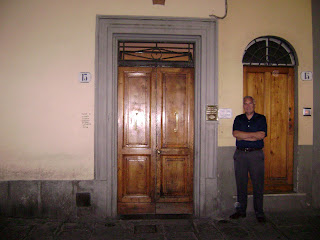
Here's Garold standing outside the entrance to our room in Casa Corsi, at Via dell'Albero, 13. We needed 3 keys here--one for the outside door, one for the hall, and another for the room. Our room was just off the kitchen. Our hostess told us we could make ourselves at home, use the kitchen, the garden, and the washing machine. By this time we were running pretty low on clean clothes, so this made us very happy! We had our breakfast each day at a nearby bar. We had a lot of fun picking out a different dolce to go with our cappuccino each morning.


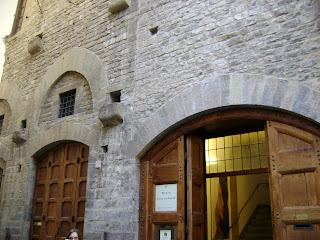
One of the first places we visited was the Museo Casa di Dante. Dante Alighieri (1265-1361), who is known as the Father of the Italian language, wrote The Divine Comedy and The Inferno.


I loved this window with its heavy wooden frame and shutters.


Here is a bedroom like the one Dante would have occupied.


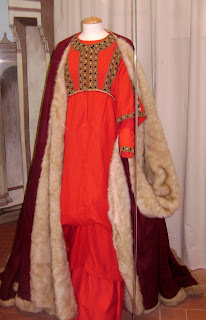
This is the kind of outfit Dante would have worn.


This is what a Florentine lady wore during the Middle Ages.

Mt. Vesuvius

So naturally, after seeing the devastation caused by the eruption of Mt. Vesuvius, we had to see it for ourselves.


We rode a bus part of the way up Mt. Vesuvius. Those bus drivers have nerves of steel!


Garold has his stick and he's ready to hike.


We stopped along the way to enjoy the view and to catch our breath. It was about a mile to the top, with a steady slope of about 30 degrees.


The hiking poles were provided at the beginning of the trail, but when we turned them in a small "donation" was requested.


Here are some photos of the inside of the crater. It was still smoking! Yikes!


Our second visit to Pompeii

After visiting the museum in Naples where we saw a miniature reproduction of Pompeii, we realized we had missed a lot. So we went back for a second look.


Here's one poor fellow who seemed resigned to his fate. The hot lava covered him and then dried to the shape of his body where it lay undisturbed for so many years. Then, when the site was excavated, they poured plaster into the hollow form to preserve his shape.


Here's another example of Italian ingenuity. Many of the homes in Pompeii had an open area in the center of their roof, with a pool or bath located directly beneath. They collected rain water and perhaps they used it as a bath.


Italians were great engineers. This room was a public bathroom. Around the walls were the seats (the supports are still there), refuse went into the ditches and then flowed out the sewer (arched opening) in the back right hand corner.


They also had public bath houses in Pompeii.


This is a large nail we saw inside the public bath.


Garold clowning around at the House of the Fawn.


Posted by Picasa

Our first visit to Pompeii

Sunday morning, October 5, we had our last cappuccino at our favorite little bar in Rome, then walked to Roma Termini and took the train to Pompeii. Unfortunately we took the train to Pompeii Scavi, which was about a mile from our B & B. There was not a local bus to take us the rest of the way. Our host, Antonio, was nice enough to come pick us up, but his car was not large enough to transport both of us and our luggage, so he had to make two trips.

This is our bedroom at Certi Notti, Via Nolana 128n, Pompeii. There was a separate sitting room with a small refrigerator and a terrace off the bedroom. It was one of the nicest rooms we stayed in, and a nice breakfast was provided by the owner's wife each morning.


Here's Garold standing in a street in Pompeii -- obviously a well-travelled one, from the looks of the wagon ruts left in the cobblestones! Pompeii was destroyed by an eruption from Mt. Vesuvius in 79 A.D. Vesuvius is considered one of the most dangerous volcanoes in the world. It has erupted repeatedly since 79 A.D., and there are currently 3,000,000 people living close to it.
And countless tourists visit it each day. Here I am walking down a cobblestone street in the ancient city of Pompeii.


The large stones in the middle of the street kept wagons in their lanes.


They had bars in Pompeii where people could stop by for a bite to eat, or perhaps to get take out for dinner. The holes in the counter held large pots of food and drink.

Perhaps they used pots like these.


High curbs probably kept pedestrians out of harm's way.


This wagon was one of the few wooden artifacts to survive Vesuvius.


Herculenium

Herculenium was a small town on the west coast of Italy that was buried under 50 feet of lava, mud and ash in August of 79 A.D. For a long time it was believed that the inhabitants of Herculenium had escaped death, but in 1981 skeletal remains were discovered, huddled together on the beach.


So we took another day trip from our B & B in Pompeii to see the ruins in Herculenium. The residents here suffered a similar fate to those in Pompeii, but the destruction was not quite so complete.


There remain a few scorched wooden beams among the stone ruins in Herculenium.


The walkway into the site provides an overview of the excavated city.


A grove of lemon trees appears to be thriving in the volcanic soil.


Garold stands inside a bar in Herculenium. In Italy a bar is still a place to stop for a quick bite to eat. Perhaps an espresso and a dolce (sweet), or a panini (sandwich).


Here again are the holes in the counter that held large pots of food. Perhaps they had roasted chestnuts instead of peanuts.


This appears to be a shrine inside a private home.


Posted by Picasa